
FiveM Resource Optimization: Writing Scripts That Cost Nothing

A FiveM resource that costs 0.00ms and one that costs 2ms usually do the same work. The difference is when they do it. This guide covers the patterns that separate the two, whether you are writing your own scripts or judging someone else's before you buy.
The per-frame loop is the whole problem
Most expensive resources contain some version of this:
while true do Wait(0) local pos = GetEntityCoords(PlayerPedId()) if #(pos - marker) < 2.0 then DrawMarker(...) end end
It runs sixty times a second forever, calculating a distance to something the player is usually nowhere near. Ten resources doing this is ten times the cost, and none of them individually look bad.
The fix is to make the wait time depend on how close the player is to caring:
while true do local sleep = 1000 local pos = GetEntityCoords(PlayerPedId()) local dist = #(pos - marker) if dist < 20.0 then sleep = 0 DrawMarker(...) end Wait(sleep) end
Far away, the loop runs once a second. Close up, it runs every frame. The player sees no difference and the idle cost drops by orders of magnitude. This single change accounts for most of the gap between a script that idles at 0.00ms and one that does not.
Prefer events and zones to polling
Better than a cheap loop is no loop. Two options replace most polling:
- Zone libraries —
ox_liband similar provide zone primitives that fire an event on enter and exit. The engine does the checking, your code runs twice per visit instead of sixty times a second. - Server events — anything driven by another player's action should arrive as an event, not be discovered by checking.
A resource built on zones and events genuinely does nothing while the player is elsewhere, which is what a 0.00ms idle reading means.
Cache what does not change
PlayerPedId() inside a per-frame loop is a native call sixty times a second for a value that changes only when the player respawns. Cache it and refresh on the respawn event. The same applies to framework objects, config lookups and anything derived from them — resolve once at start, reuse.
This matters more in FiveM than in ordinary Lua because native calls cross into the game engine. They are not free, and a loop making six of them per frame is doing three hundred and sixty engine crossings a second to learn nothing new.
Draw only what is visible
Markers, 3D text and NUI all cost while they are on screen. Gate them on distance the same way as the loop above, and stop drawing entirely when the player cannot see the thing. A common mistake is drawing text at a distance where it renders as a single unreadable pixel — the cost is identical to drawing it up close.
Keep server work off the tick
On the server side, the equivalent sin is blocking the tick. A synchronous database query inside a frequently-called handler stalls everything for its duration, and the symptom is every player rubber-banding at the same instant. Use the async API, index the columns you filter on, and do not query inside loops.
Measure your own work
resmon 1 shows your resource alongside everything else. Read it in three states: idle with the player far away, near the feature, and using the feature. A well-written resource reads 0.00ms in the first state, which is the state the player spends almost all their time in.
If you are evaluating a script before buying, this is the test worth running on a copy of your server. Idle cost is the honest number — peak cost during use matters far less because it is brief and rare.
Judging a script you did not write
Without source access, ask for the idle figure and verify it in resmon yourself. With source access, search for Wait(0) and read every result: each one is a per-frame loop, and each should be inside a distance check that raises the wait when the player is far away. That single grep tells you more about a resource's cost than its feature list.
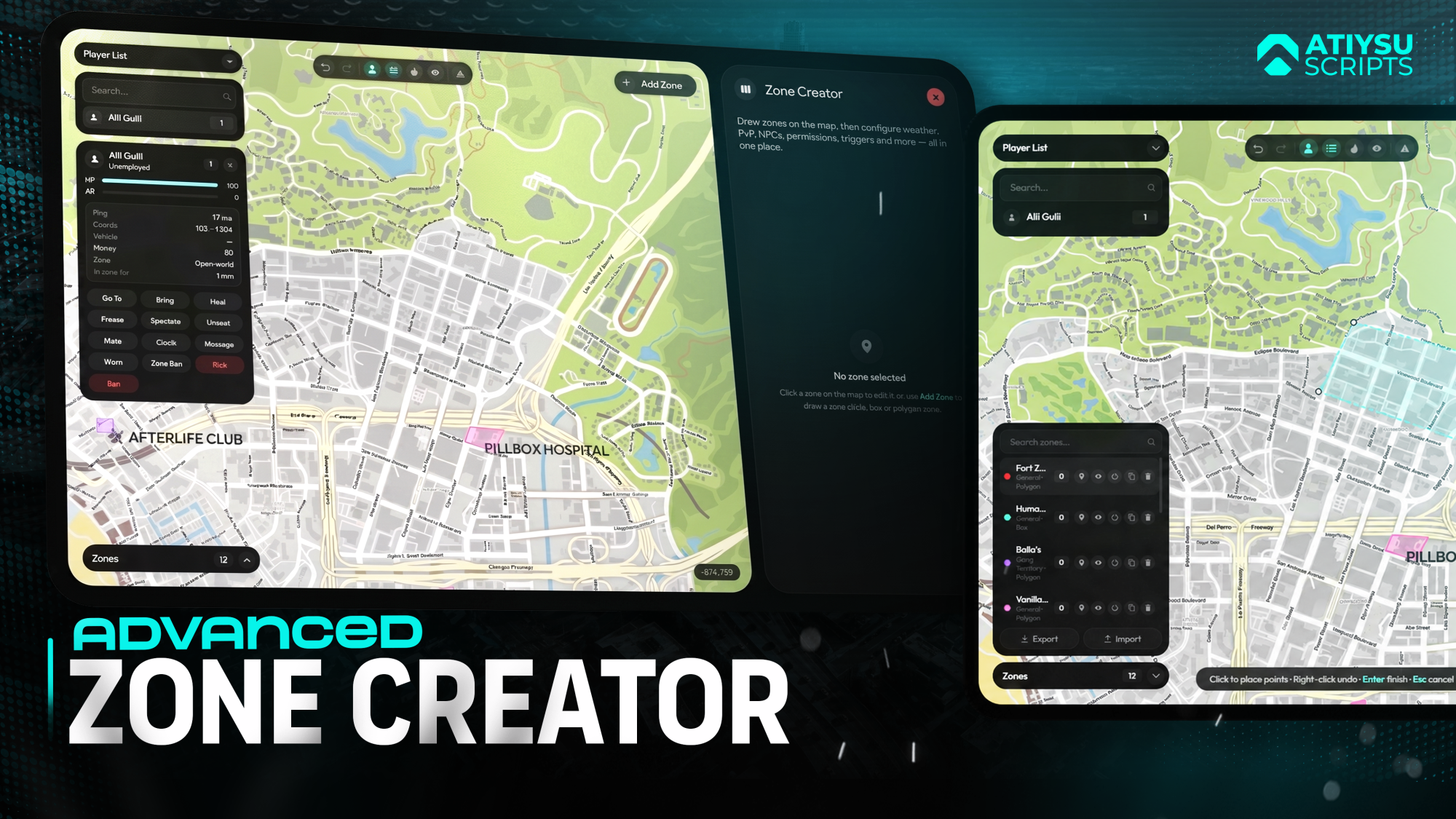
Our FiveM Zone Manager is a useful example of the zone-based approach — it exists so other resources can stop polling and react to zone events instead.
Where to go next
For the server-wide view — finding which resource is the problem in the first place — read our FiveM server optimization guide.
Every ATY script ships with its own setup page in the documentation, and delivery is automatic through Cfx.re Keymaster the moment payment clears. Browse the full catalogue in the store, or open a ticket in our Discord if you get stuck — you talk to the developers who wrote the code.
Producto de este artículo
FiveM Resource Optimization: Writing Scripts That Cost Nothing